

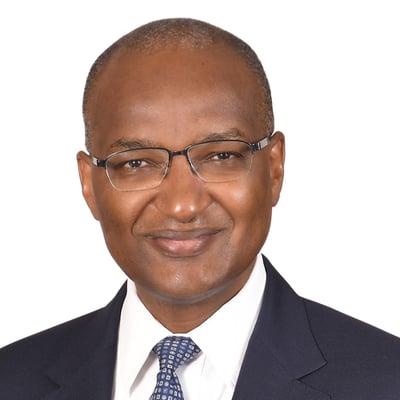
Dr. Patrick Njoroge
Former Governor
Central Bank of Kenya
Dr. Patrick Njoroge served as the ninth Governor of the Central Bank of Kenya from June 2015 to June 2023, after a 20-year career at the International Monetary Fund. He is currently a member of the Advisory Boards of the "Yale Program on Financial Stability" and the "Global Finance and Technology Network," chair of the "Africa Financial Industry Summit" (AFIS) Supervisory Council, and a member of the Africa Expert Panel for South Africa’s G20 Presidency. He has received several awards and recognitions, including four awards for Africa’s Central Banker of the Year, and recognition in 2023 as a Top 25 African Finance Leader. He holds a PhD in Economics from Yale University. He is MLK, Jr. and Phyllis Wallace Visiting Scholar at MIT Sloan School of Management.
Speaking at
-
10:15–10:30amTue 25 AugForum StageCentral Asian Expocenter (CAEx)Open
Others
How Networks Leapfrog Nations
About this session
This keynote will set out how technology, strong global networks, standards & partnerships can accelerate adoption of financial services in Central Asia & help the region leap onto the world’s fintech stage.
-
3:15–3:55pmTue 25 AugForum StageCentral Asian Expocenter (CAEx)
Securing the Future
The School on the Silk Road: Demographic Dividend, or Demographic Debt?
-
 Dr. Abdel Aziz NossierExecutive DirectorEgyptian Banking Institute
-
 Gulnoza IsmailovaExecutive Director of the “El-Yurt Umidi” Foundation for the Training of Prospective PersonnelEl-Yurt Foundation
-
Leiming ChenSenior Vice President & Chief Sustainability OfficerAnt International
-
 Dr. Patrick NjorogeFormer GovernorCentral Bank of Kenya
-
 Pieter FrankenGroup Chief Technology OfficerGlobal Finance & Technology Network (GFTN)Moderator
About this session
Every great city on this road was also a school. Uzbekistan's median age is 27, and a Presidential Decree calls for 5,000 trained fintech professionals by 2030 — but a young population is only an advantage if it's activated. Talent is the input every other pillar depends on: no engineers, no ecosystem; no skilled supervisors, no safe infrastructure. This panel is about building that human capital deliberately — aligning universities, industry-led training and public programmes with what the market actually needs, financing it at scale, and, crucially, keeping the talent in the region once it's trained. The harder questions sit underneath the target: whether a degree still signals fintech-readiness or whether skills-first credentials do, who pays for training at national scale, and how a country turns a demographic bulge into an exportable strength rather than a wave of emigration.
-

