
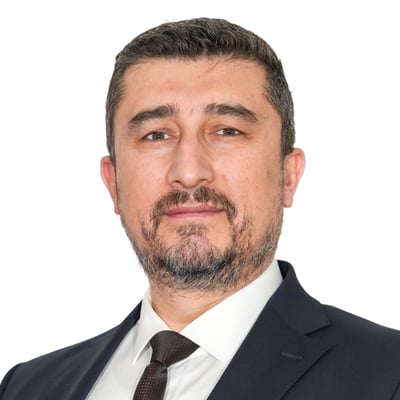
Dr. Tarik Akin
Head of the Finance Department
Investment & Finance Office of the Presidency of the Republic of Türkiye
Tarık Akın (PhD.) currently serves as the Head of Finance Department at Investment and Finance Office of the Presidency of the Republic of Türkiye. The Department has four main units, namely, participation finance, fintech, financial investments, and financial markets. Dr. Akın was the Head of the Department of Participation Finance at Finance Office of the Presidency of the Republic of Türkiye between 2021 and 2025. Dr. Akın also worked at the Undersecretariat of Treasury, Islamic Financial Services Board (IFSB), World Bank, UNDP, Silatech-Qatar, and Center for International Development (CID) at Harvard University. He was SC–OCIS Visiting Fellow in Islamic Finance at University of Oxford for the academic year 2019-2020. He earned his bachelor’s degree from Bilkent University, master’s degree from Harvard University and PhD. degree from INCEIF University. His main areas of expertise include Islamic finance, capital markets, macro-financial linkages, and redistribution policies.
Speaking at
-
11:15–11:35amWed 26 AugForum StageIslamic Civilisation Centre (ICC)
Others
Azimuth Fireside: Strategy and Capacity - What It Actually Takes to Build a National Islamic Finance System
-
 Dr. Abdel Aziz NossierExecutive DirectorEgyptian Banking Institute
-
 Dr. Tarik AkinHead of the Finance DepartmentInvestment & Finance Office of the Presidency of the Republic of Türkiye
-
 Sopnendu MohantyGroup Chief Executive OfficerGlobal Finance & Technology Network (GFTN)Moderator
About this session
A national Islamic finance strategy is easy to write. It is hard to execute. The gap between the two is almost always the same: the supervisors, institutions, and workforce needed to implement it do not yet exist when the policy is signed. Turkey published its first Participation Finance Strategy in 2022. Egypt has been building Islamic finance infrastructure for decades. Both have learned that sequencing matters as much as ambition — and that what gets built in the first three years determines whether a market scales or stalls.
This session puts the policy architect and the capacity builder in conversation: what does a second-generation strategy look like, and what does the first generation teach you about what to build before you write it? For Uzbekistan, which has the law and the mandate, the question is not whether — it is in what order. Audience will leave with a clear framework for sequencing strategy and capacity, and a practical read on what to prioritise now from 2 countries that have already made the mistakes. -

